
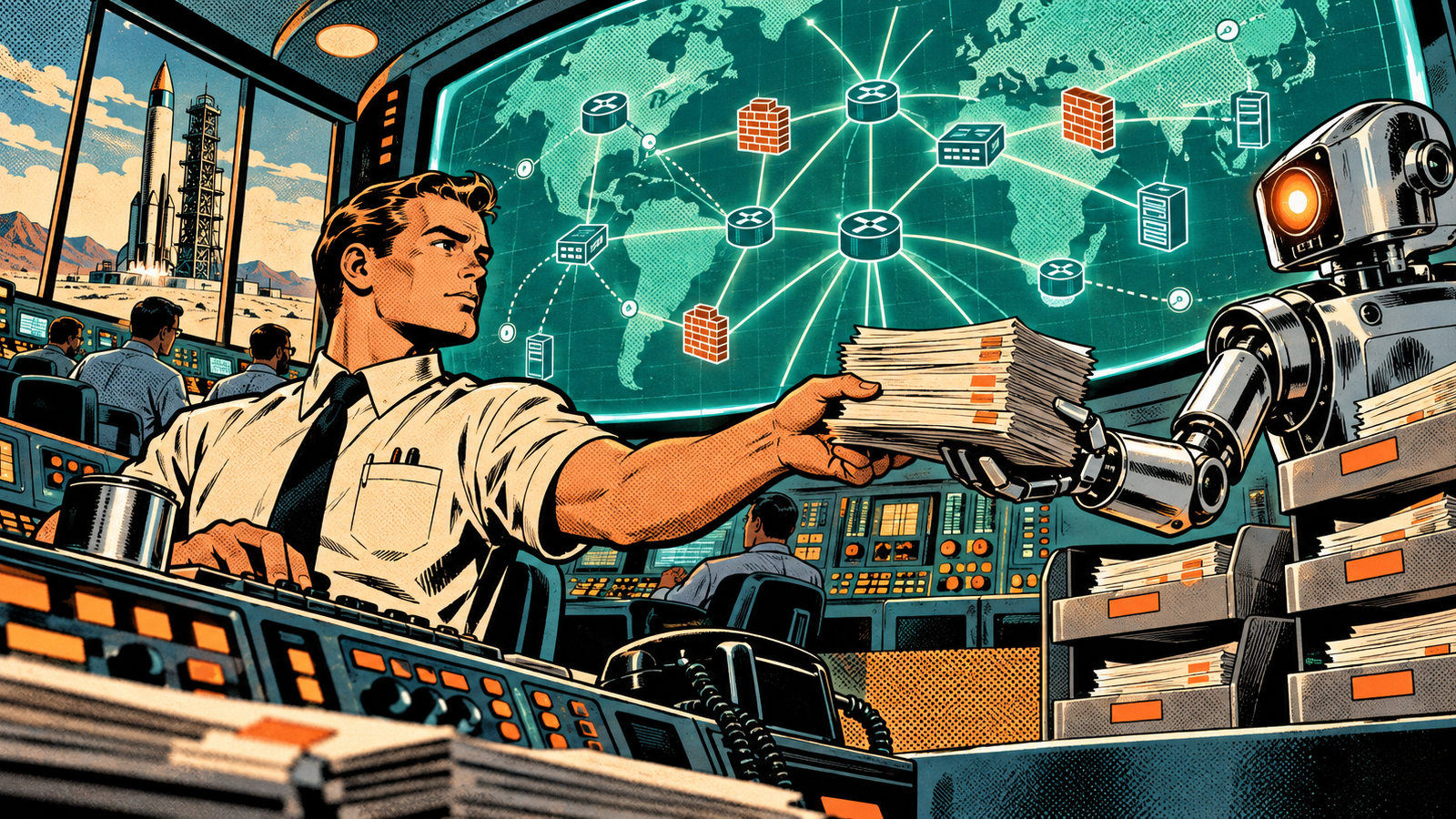
Is AI going to replace network engineers? Honestly, I don’t think so. But I do think it’s going to change what our roles look like, and I think it’s going to split us into two groups.
On one side, you’ve got the engineers using it to finally build the automation they haven’t had time for in years. On the other, you’ve got the ones still doing everything by hand. And the gap between those two groups is going to grow faster and faster.
I’ve been in IT for eleven years, and I use AI at my job and in my lab. So here are the three jobs I’d hand to AI first, what it looks like when you chain them together, what it still won’t do for you, and what you get back.
Why this hits network engineers so hard
Most of us are on small teams, a few network people if that, running multi-vendor networks. We own the routing, the switching, the firewalls and the security.
- Unless you’re at a big company with a dedicated automation team, nobody ever gave you the time to learn to code and then build the automation.
- The manual work keeps coming, so the backlog barely moves.
- Every new vendor in your environment adds more advisories to read and more devices to check.
Python isn’t my strongest skill either. I can read it, but writing it from scratch is slow for me. When I figured out AI could write the code for me, as long as I knew my network fundamentals and could tell it exactly what I wanted, I could finally do the automation I’d been wanting to do for years.
Three jobs I’d hand to AI first
1. Testing apps before and after a firewall cutover
During a firewall cutover, I had Claude go through the firewall rules and build me a list of the apps I needed to test. Then it wrote a curl script that tested every one of those apps before the cutover and again after, to make sure they all responded the same way.
It didn’t stop at curl. After the cutover, it checked the hit counts on the rules and went through the logs to make sure nothing was getting blocked that shouldn’t be.
So instead of finding out at 7 a.m. that an app is broken, you already know. You go to bed with high confidence that the change is good. On a late-night cutover, that saved me a lot of time.
2. Security advisory triage
It feels like there’s a new zero-day almost every day. Somebody has to read every advisory, then check what you’re actually running, what version it’s on, and whether you even use the feature that’s vulnerable.
When you think about it, that’s a matching problem. And matching data is something AI is good at. I built a version of this in my agents video, and Cisco publishes its advisories through a free API, the PSIRT openVuln API. You can build this in a lab tonight.
3. The “are we affected?” question
This one branches off the last one, and it eats more time than you’d think. Somebody sees a post about a new vulnerability and messages you: “Hey, are we affected by this?”
Say it only matters if you’re running IPsec VPN on that router or firewall. You probably aren’t. But maybe it got turned on eight years ago, before you got there, and nobody has checked since.
Now picture pasting that question into an AI tool that already knows your network. It checks the advisory against what you run and hands you a draft answer. You still read it before it goes out.
What it looks like when you chain them together
Picture a system that pulls the security advisories from every vendor you run and checks them against your live network. If it doesn’t have the state it needs, it runs the show commands itself, so you’re not logging in to twenty, fifty or a hundred devices by hand.
Then it tells you that you’re affected by this advisory and not by those other three. It opens the ticket, creates the change request and sends it for approval. Once it’s approved, it downloads the software, and when you tell it to go, it runs the pre-check, the upgrade and the post-check, then messages you when it’s done.
This is a hypothetical example. But it takes you from advisory to patched in one automated flow, and you still review and approve the change before it touches anything.
What AI still won’t do for you
There are two things I don’t see AI doing for you anytime soon.
It doesn’t know your network unless you give it context. Without that context, it’s guessing. If you’ve never handed an AI tool the full picture of a device and then asked it questions, try it once. Save your running config, show ip route, show vlan and show cdp neighbors. Or ask your AI tool which show commands would give it the full context of your network, run those, save them to a file, and give that file to an AI tool your company approves for that data. The difference in the answers is huge.
Long term, you either need a source of truth or you can have AI build you one, like a YAML file of your whole network. You don’t need to buy a tool for that. It needs read access to your devices so it can run show commands. My network documentation video shows AI turning show command output into real documentation.
It isn’t you. You’re still the one signing off on the change, and it still has your name on it. AI agents may get their own identities down the road, but somebody still owns that agent and a human is still responsible for what it does.
That goes for read-only work too. If you fire show commands at a thousand devices at once, could that cause problems on your network? Maybe, maybe not. You need to know before you do it. And if there’s anything in a script you don’t understand, ask the AI to explain it in terms of the Cisco CLI you’ve been typing for years, before it goes anywhere near production.
What you actually get back
You get time to go after the backlog, like the routing that needs cleaning up, or that 500-line ACL with eight years of rules and objects nobody wants to touch.
When the mundane work runs itself, you get to be a network engineer instead of a network maintainer. And I think that’s the engineer who gets promoted: the one making the engineering decisions, the improvements and the resiliency changes.
The government’s numbers point the same way. The Bureau of Labor Statistics projects network and computer systems administrator jobs shrinking about 4% by 2035 and network architect jobs growing about 8%. It names AI as one of the reasons companies need architects.
And the time you free up compounds. You spend some of it learning the next automation, which frees up more time, and so on.
When the Network Automation Forum asked about 400 network folks in 2025 how automation was affecting their staffing, only about 2% said it was reducing staff. About half said they were training the people they already had. I’ll link the 2026 results when they’re published.
Honest limitations
- The chained advisory-to-patched system above is a hypothetical. I’m describing where this can go, not something I’m running end to end.
- AI will be confidently wrong at some point. Set each job up so a wrong answer is easy to spot, and prove it in a lab before you trust it.
- Everything here assumes an AI tool your company has approved for your configs and device output. Don’t paste real network data into a free consumer chat.
Get the guide
I wrote up the five jobs I’d hand to AI first, with how AI does each one, what it needs, a starter prompt and where it still needs you. It’s free to read on the site: My Top 5 Ways to Start Using AI as a Network Engineer.
I don’t think AI is going to take our jobs as network engineers. I think it’s going to give us our lives back.